Don't Learn Arabic the Old Way
Ustazah Alaa · June 23, 2025 · 5 min read
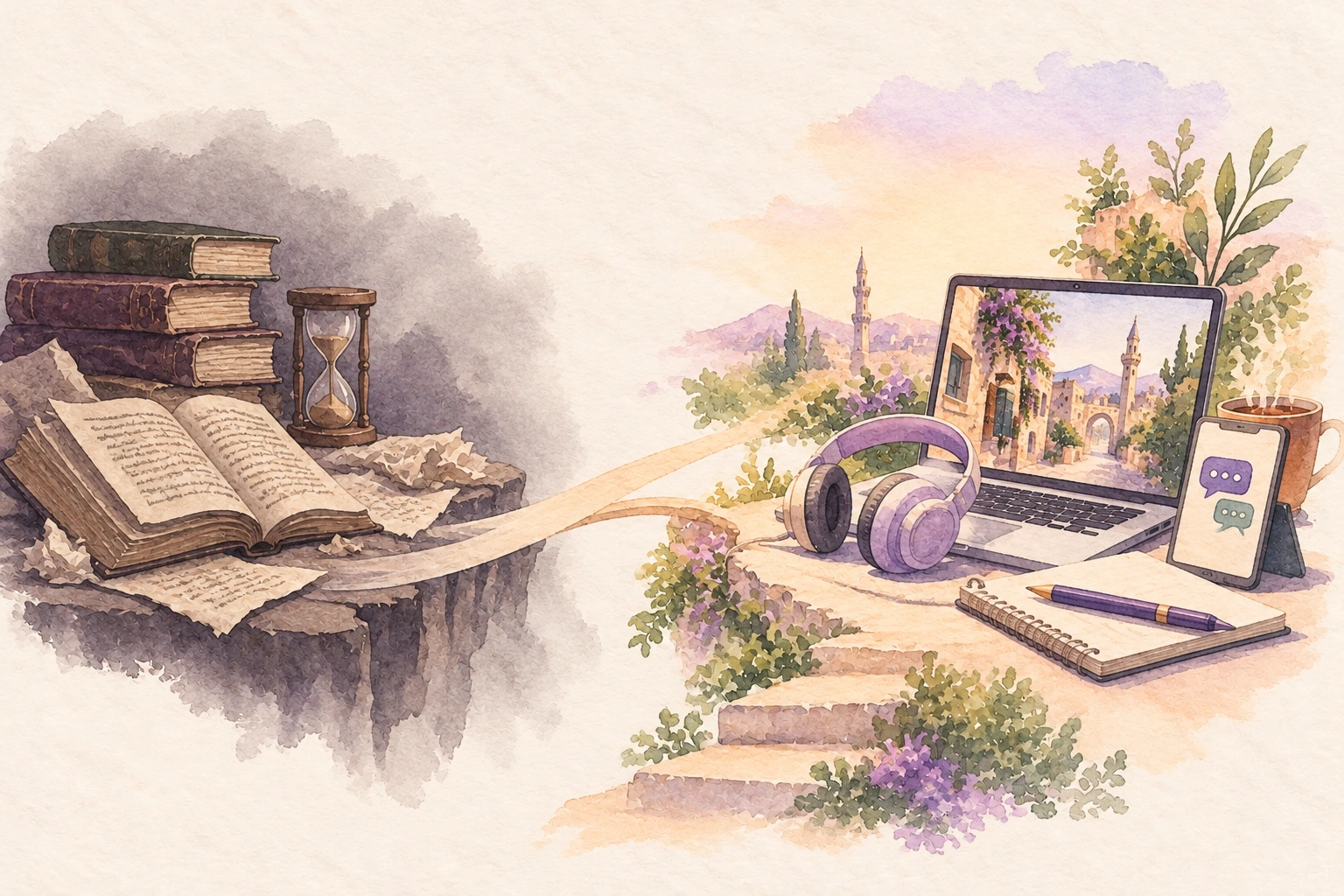
Quick Answer
You do not have to learn Arabic only the old, formal way. The Arabic of the Quran and books (Fusha) is beautiful and important, but it is not the Arabic people use to joke, argue, flirt or order coffee. If you want to talk to Arabs, start with a spoken dialect like Shami (Syrian and Levantine Arabic), and add Fusha when you need it.
A Letter From My Heart to Every Malaysian Learning Arabic
Many Malaysians start learning Arabic because they want to read the Quran. I respect that deeply. The Quran is sacred.
But Arabic is also something else. It is the language of people. It carries emotions, humor, love and daily life. It is what a mother says when she scolds her child, and what two friends say when they tease each other.
Most learners are taught only Modern Standard Arabic (MSA, or Fusha): the formal Arabic of news bulletins, Friday sermons and old books. It is almost never used in everyday conversation.
What Happens When You Only Speak Fusha?
Try speaking formal Arabic in Damascus, Beirut or Cairo, and you will probably get a polite smile, or a laugh.
Imagine walking into a café today and saying, "Prithee, good sir, might I partake in thine finest brew?" Nobody would be rude about it, but everybody would notice. That is how formal Arabic can sound in a normal conversation.
MSA is not the language of music videos, Instagram, Arab TV dramas, casual phone calls or friends teasing each other. Learning only Fusha can feel like trying to swim with your hands tied.
If you want to understand Arabs, travel, make friends, watch Arabic content or work in the Middle East, you need a spoken dialect.
What Does the Difference Look Like?
The same idea, said two ways:
| English | Formal Arabic (MSA) | Shami (spoken) | Shami pronunciation |
|---|---|---|---|
| How are you? | كيف حالك؟ | كيفك؟ | kīfak? |
| What do you want? | ماذا تريد؟ | شو بدّك؟ | shū biddak? |
| I don't know | لا أعرف | ما بعرف | mā baʿref |
| Now | الآن | هلأ | hallaʾ |
| Very good | جيد جداً | كتير منيح | ktīr mnīḥ |
شو بدّك؟ shū biddak? "What do you want?"
Both columns are correct Arabic. Only one of them is what you will hear on the street.
Why Shami?
I recommend Shami, the Syrian and Levantine dialect, for a few reasons.
- It is familiar to many Arabs. Decades of Syrian drama, music and comedy have made it widely understood across the region. (Some dialects, such as Moroccan Arabic, can still be harder to follow.)
- It is soft, emotional and expressive.
- It is close enough to Fusha to help you build both spoken and formal skills over time.
For me, it is the golden middle: friendly enough to speak from day one, and close enough to classical Arabic to grow into it.
Why Do Most Arabic Courses in Malaysia Skip Dialects?
Most courses tell students to start with Fusha because it is "pure". But pure does not always mean practical.
Arabic should be taught based on what you want from it, not as one-size-fits-all. If your goal is to understand the Quran, MSA is perfect. If you want to live the language, joke in it and connect with people, you need a dialect too.
This is not an attack on Fusha. I love it, and I grew up with it. I simply believe you should choose your path with your eyes open.
How Do You Choose Your Path?
If you are in Malaysia and thinking of learning Arabic, pause for a moment and ask yourself one question: why do I want this language?
Then choose the path that fits your answer. That is the whole idea behind a more honest, human and real way of teaching Arabic, and it is the path we are building here in Malaysia, at your own pace.
For a deeper look at the choice, read Syrian Dialect vs MSA: Which First?.
Did You Know?
The word شامي (shāmī) simply means "from ash-Shām", the Arabic name for the region that includes Syria, Lebanon, Palestine and Jordan. In older usage, الشام (ash-Shām) often meant Damascus itself. So when we say "Shami Arabic", we mean the Arabic of the Levant.
Summary
- Arabic is not only a religious language. It is also the language of daily life.
- Fusha (MSA) is formal and important, but rarely spoken in conversation.
- Speaking only formal Arabic can sound unnatural to Arabs.
- Shami is soft, expressive, widely understood and close to Fusha.
- Choose your path by asking: why do I want this language?
- Learning a dialect does not mean giving up Fusha.
Frequently Asked Questions
Do I Have to Learn Fusha to Speak Arabic?
No. You can learn a spoken dialect first and add Fusha later, depending on your goals.
What Is Shami Arabic?
Shami is the Arabic dialect of the Levant: Syria, Lebanon, Palestine and Jordan.
Is Shami Understood in Other Arab Countries?
Mostly, yes. Syrian drama and music have made it familiar across much of the Arab world, though some dialects can still be harder to follow.
Is Learning a Dialect Disrespectful to the Quran?
No. Learning a dialect does not replace Fusha. Many learners study both, for different purposes.
Why Do Malaysian Students Struggle to Speak Arabic After Years of Study?
Often because courses teach only formal Arabic, which is rarely used in conversation. Adding a spoken dialect closes that gap.
Keep Learning
If this message spoke to you and you want a more human way to learn Arabic, I would love to have you. Contact us, or message us on WhatsApp with any question about the Shami dialect.
My book Master Levantine Arabic is the first of its kind in Malaysia for real, spoken Arabic in everyday situations, for all levels. You can find it on Shopee Malaysia, or read more here.
Want a small first step? Try 5 Tips to Master Arabic Language.