Syrian Dialect vs MSA: Which First?
Ustazah Alaa · June 24, 2025 · 6 min read
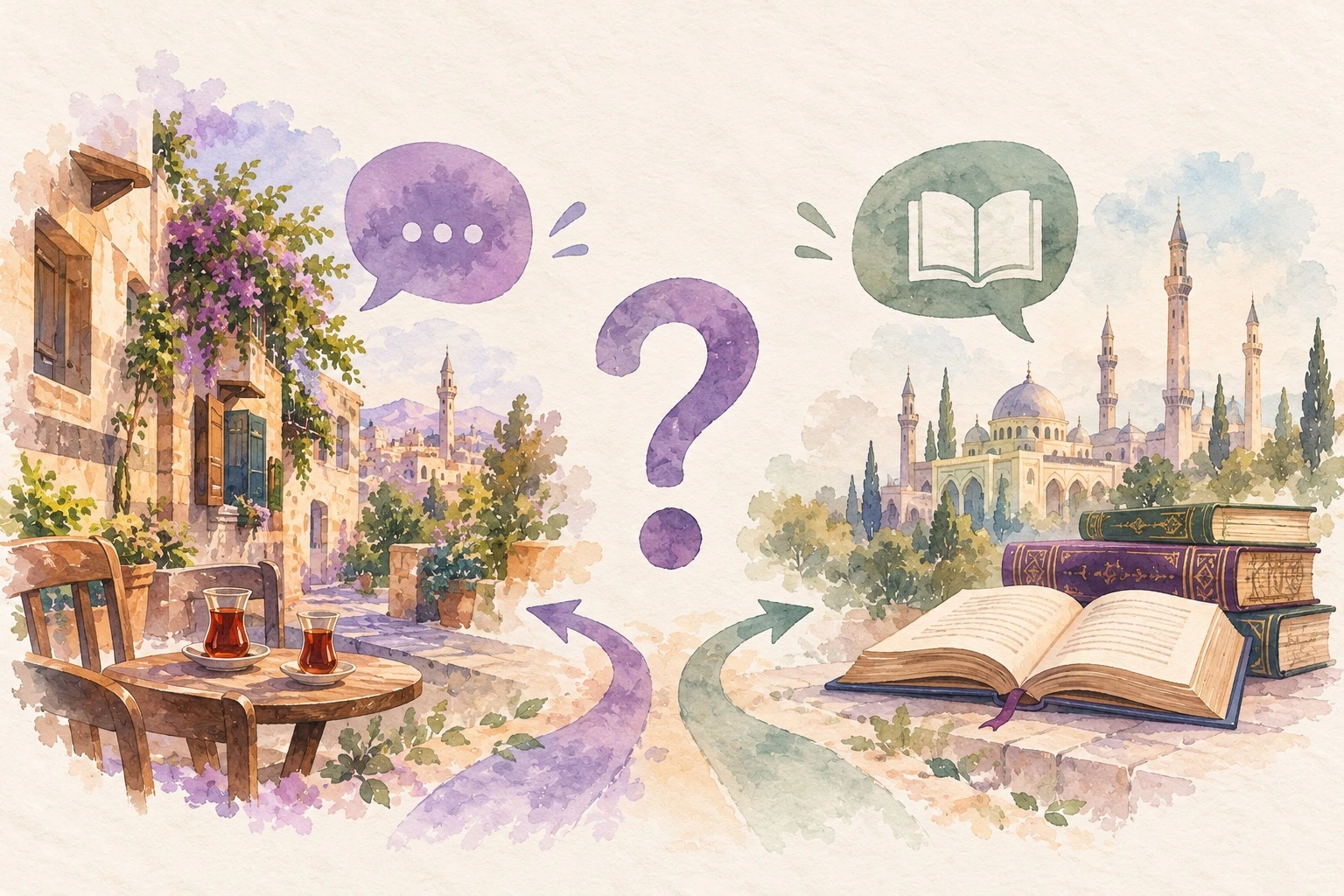
Quick Answer
If you want to speak Arabic with real people, start with the Syrian (Levantine) dialect. If your main goal is to read the Quran or formal texts, start with Modern Standard Arabic (MSA, also called Fusha). You do not have to choose forever. It is only a question of where to begin, and you can add the other one later.
Introduction
Many Arabic learners in Malaysia begin because they want to understand the Quran. That is a beautiful reason. But it also leads to a question that almost every student asks sooner or later: which Arabic should I learn first?
The answer matters more than it seems. Arabic is not one single way of speaking. The formal Arabic you read in books is very different from the Arabic people use at home, in the market and on the phone. Choose the wrong starting point for your goal, and you can spend months studying without ever feeling that you can actually talk to anyone.
In this guide, we will look at what MSA is, what Syrian Arabic is, how they differ in a real sentence, and how to decide which one fits you.
What Is Modern Standard Arabic (MSA)?
MSA, known in Arabic as الفصحى (al-fuṣḥā), is the formal Arabic of newspapers, books, official speeches and news broadcasts. It is also the language of the Quran in its classical form.
It is precise, structured and elegant. But almost nobody uses it for everyday conversation. A person in Damascus, Beirut, Amman or Cairo does not chat with friends in Fusha. They use their own dialect.
What Is Syrian (Levantine) Arabic?
Levantine Arabic is the everyday spoken Arabic of Syria, Lebanon, Palestine and Jordan. Syrian Arabic is one of its best-known varieties. You hear it in conversations, dramas, YouTube videos, podcasts and on the street.
Learners often like it for three reasons:
- It sounds softer and is easier to pronounce.
- It is widely understood across the Arab world, thanks to dramas and music.
- It feels natural and human, with humor, emotion and slang.
How Are Syrian Arabic and MSA Different?
| Syrian (Levantine) Arabic | Modern Standard Arabic (MSA) | |
|---|---|---|
| Where you hear it | Conversations, dramas, social media, daily life | News, books, speeches, the Quran |
| Written or spoken | Mainly spoken | Mainly written and formal |
| Sound | Soft and relaxed | Formal and precise |
| Grammar | Simpler in everyday use | Full case endings and verb forms |
| Best for | Speaking and making friends | Reading and formal settings |
Which One Should You Learn First?
It depends on what you want to do.
Start with MSA if you only want to read classical texts or the Quran.
Start with Levantine if you want to:
- speak in real conversations
- understand Arabic media
- visit or live in an Arab country
- make Arab friends and chat with confidence
For most learners who want to use Arabic, Levantine is the faster and more enjoyable path.
Why Does Learning MSA First Feel So Hard?
Fusha can feel intimidating for a beginner. You meet long vowel rules, complicated verb forms, gender and case endings, and sentence structures that sound unnatural in daily life.
The result is familiar to many students. After months of study, you can recite a rule, but you still cannot ask "Where is the bathroom?" or "How much is this?"
What Do Malaysian Students Tell Us?
I have taught many Malaysian students, and I hear the same story again and again: "I studied Arabic for years at school, but I still cannot speak."
The reason is usually simple. They were taught only Fusha. And here is something that surprises people: most Arabs do not speak Fusha fluently either. For them, it is a bit like Shakespearean English. People respect it and read it, but they do not use it to order lunch.
What Does the Difference Look Like in Real Life?
Imagine you arrive in Lebanon, Jordan or Syria and want to say: "I am learning Arabic. Can you help me?"
| Version | Arabic | Pronunciation | How it feels |
|---|---|---|---|
| MSA | أنا أَتَعَلَّمُ اللُّغَةَ العَرَبِيَّةَ. هَلْ يُمْكِنُكَ مُسَاعَدَتِي؟ | ana ataʿallamu l-lughata l-ʿarabiyya. hal yumkinuka musāʿadatī? | Correct, but stiff |
| Levantine | عَمْ أَتْعَلَّمْ عَرَبِي، بِتْقِدَرْ تِسَاعِدْنِي؟ | ʿam atʿallam ʿarabī, bitqdar tisāʿidnī? | Natural, friendly and human |
عَمْ أَتْعَلَّمْ عَرَبِي ʿam atʿallam ʿarabī "I'm learning Arabic"
Both sentences mean the same thing. But only one of them sounds like something a person would really say.
What Is the Best Way to Start?
Start with the spoken dialect, specifically Syrian Arabic, if your goal is to connect, communicate and enjoy learning. Once you feel confident speaking, add Fusha for reading, the Quran and formal situations.
Learning the dialect first does not close the door on Fusha. It builds the speaking confidence and motivation that make it easier to keep going later.
Did You Know?
The word فصحى (fuṣḥā) comes from a root meaning "eloquent", so Fusha literally means "the most eloquent Arabic". The spoken dialects are called عامّية (ʿāmmiyya), from a word meaning "common" or "of the people". The two names say a lot: one is the language of the page, the other is the language of the people.
Summary
- MSA (Fusha) is formal Arabic for books, news and the Quran.
- Syrian (Levantine) Arabic is the everyday spoken Arabic of Syria, Lebanon, Palestine and Jordan.
- Choose Levantine first if you want to speak, understand media and make friends.
- Choose MSA first if you only want to read classical texts or the Quran.
- Most Arabs do not speak Fusha in daily life.
- You can learn both. The question is only which one to start with.
Frequently Asked Questions
Should I Learn Syrian Arabic or MSA First?
If you want to speak with people, start with Syrian (Levantine) Arabic. If you only want to read the Quran or formal texts, start with MSA.
Is Syrian Arabic Easier Than MSA?
Most learners find it easier to speak, because the pronunciation is softer and the everyday grammar is simpler.
Will People in Other Arab Countries Understand Syrian Arabic?
Mostly yes. Syrian and Levantine Arabic are widely understood because of dramas, music and social media.
Can I Learn the Quran With the Dialect?
The Quran is in classical Arabic, so you will need Fusha for that. Many learners build speaking confidence with the dialect first, then add Fusha later.
Do Arabs Speak MSA in Daily Life?
No. MSA is used in news, books and speeches. In daily life, people speak their own dialect.
Keep Learning
Ready to speak Arabic for real? My online classes are made for Malaysians who want to speak Arabic, with a focus on everyday conversation, in a friendly and pressure-free way. Join a class or see our programs.
Want to start with something small? Try Days of the Week in Levantine Arabic, or take a look at my Levantine Arabic book.